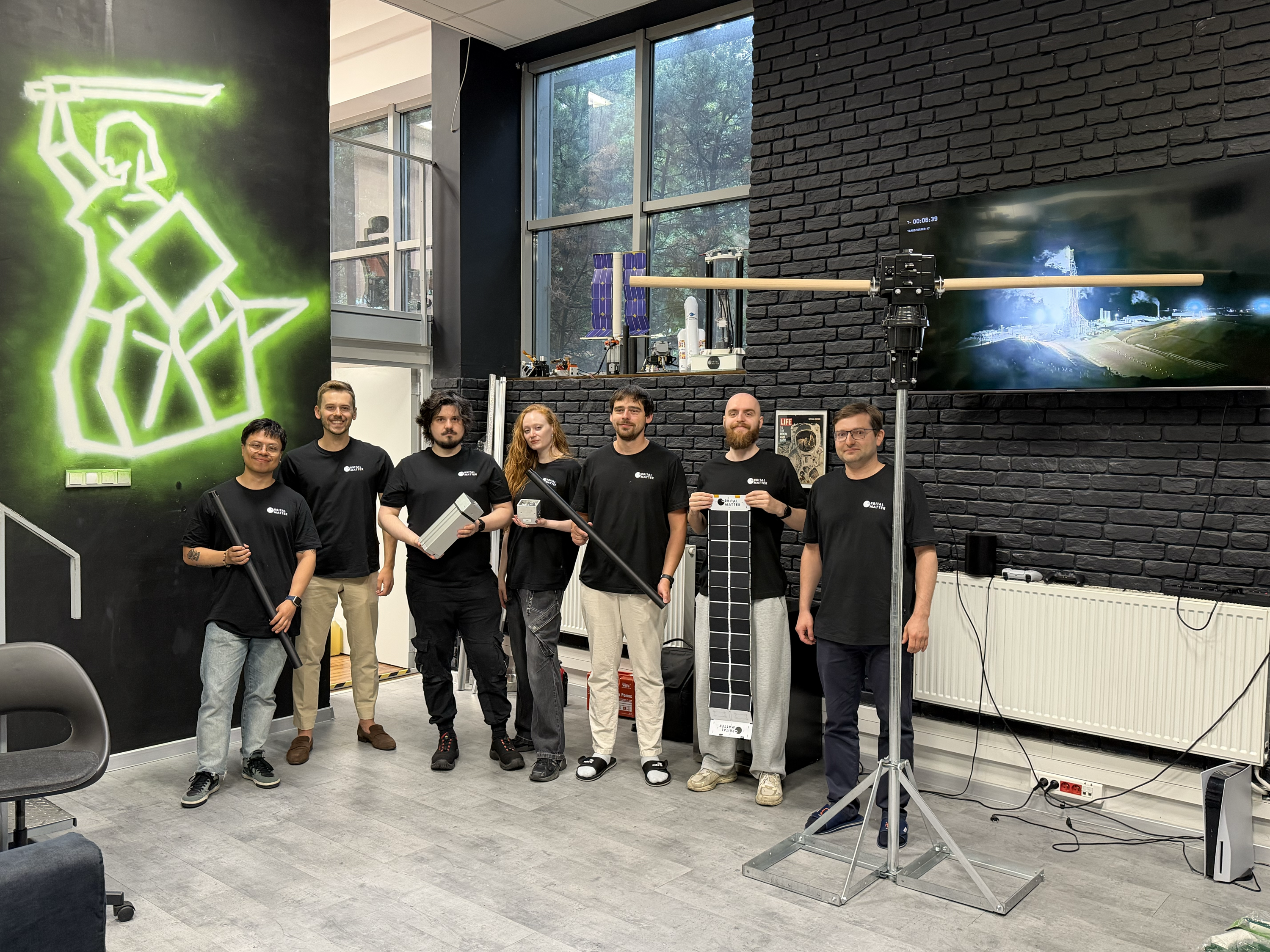
Warsaw, Poland, 7 July 2026. Orbital Matter today launched Replicator 2, a satellite designed to manufacture solar array structures directly in Earth's orbit. Launched aboard SpaceX's Falcon 9 Transporter-17 mission, Replicator 2 will attempt to achieve an industry first: 3D printing rigid, structural elements in the exposed vacuum of space, and using them to deploy a solar array. This is a critical step toward solar arrays far larger than current deployable technology can build.
In the space industry, scaling fast is the next goal. Next-generation satellite constellations and orbital data centers need solar arrays in the tens of kilowatts, far larger than anything that flies today. Current solar arrays are folded on Earth and unfolded in orbit using hinges, latches, motors and tensioning systems. That approach works well at small scale but breaks down as structures grow: every added meter means more mechanical complexity, more failure points, and costs that rise faster than array size.
Orbital Matter takes a different approach: it builds the structure in space instead. Replicator 2 is an 8U CubeSat, weighing roughly 13 kilograms, carrying four of the company's 1U 3D printer modules. Each printer extrudes a photopolymer resin and cures it with UV light into a one-meter rigid boom, with no hinges and no moving parts in the finished structure. Two of the printed booms deploy a stowed flexible solar array, a scaled demonstrator that validates the full print-and-deploy sequence end to end. The remaining two deploy an antenna and a camera. The four printers operate independently, so any single successful boom proves the technology in flight.
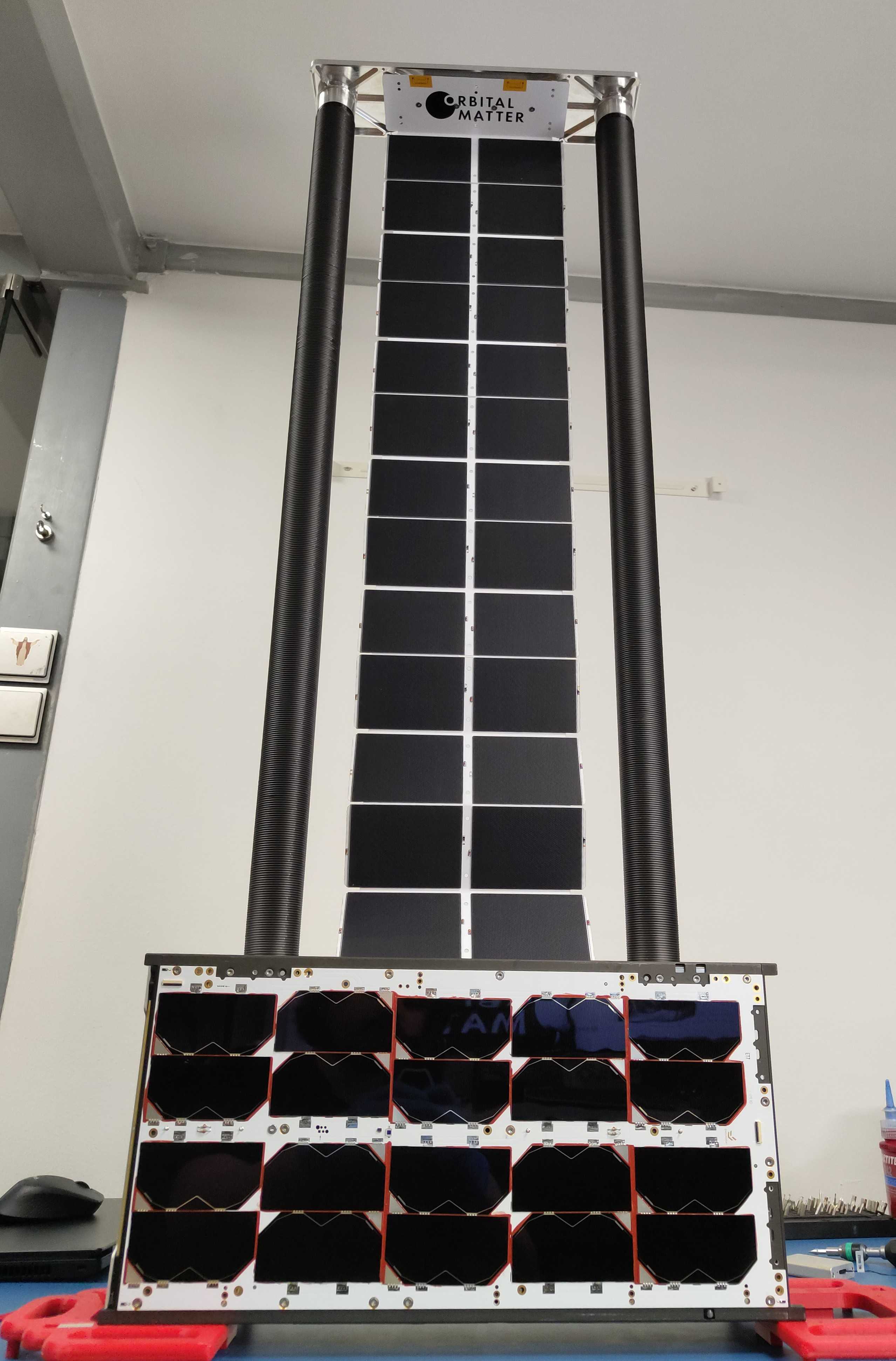
Because the structure is printed as one continuous piece rather than folded, it scales in a way mechanical deployables cannot. The same compact module can produce booms over 100m long, and the cost per meter falls as the structure grows. That inverts the economics of large space structures: the bigger the solar array the market demands, the stronger the case for building it in orbit.
Replicator 2 also marks a genuine first for the industry. All previous in-space manufacturing was carried out inside the pressurized environment of the International Space Station. Replicator 2 operates in open space, in an unpressurized environment and microgravity.
The whole industry is converging on the same wall. The power that data centers and edge computing satellites need calls for solar arrays larger than any existing deployment method can unfold. Replicator 2 is the first proof that we can simply build the array in space, at whatever size the mission demands. Jakub Stojek, CEO and co-founder of Orbital Matter
Each printer is the size of a 1U module and produces a rigid boom with no length limit and no moving parts to jam. Four of them fly on this mission. Watching them build a solar array in orbit is the moment the technology stops being a lab result. Robert Ihnatisin, CTO and co-founder of Orbital Matter
About Orbital Matter
Orbital Matter builds solar arrays larger than possible with existing technologies. Its printers replace traditional deployment methods by manufacturing continuous rigid structures directly in orbit, providing the structural backbone for solar arrays without physical limits of existing unfolding mechanisms. The company is headquartered in Berlin, Germany, with its main office and R&D in Warsaw, Poland.
Media contact: Jakub Stojek, CEO, jakub.stojek@orbital-matter.com