TECHNOLOGY
Next-generation constellations, space data centers, and high-power communication systems all require solar arrays, radiators, and antennas far larger than what can be folded into a fairing and survive launch. The structural limit is no longer a design problem — it's a manufacturing location problem. We build structures directly in orbit — no hinges, no latches, no size limit.
HOW IT WORKS
Concrete is the most widely used construction material on Earth because it starts as liquid and cures on-site. Orbital Matter applies the same principle in orbit — using photopolymer resin and UV light instead of cement and water.
STEP 1
Photopolymer resin is stored as fluid inside the printer module. It flows through a precision extrusion head, forming the structure profile layer by layer. Because the raw material is liquid, it conforms to any reservoir shape — maximizing packing efficiency inside the satellite bus.
STEP 2
A precisely tuned UV light source rapidly hardens the resin as it is extruded. UV curing avoids the thermal complexity of melt-based processes — resulting in lower power demand than a light bulb. The entire print mechanism uses a single motor, reducing failure modes to a minimum.
STEP 3
The result is a continuous structure — rigid, dimensionally stable, and free of joints or mechanical connections. Structure size is limited only by the amount of raw material carried. The larger the structure, the simpler and cheaper it gets per meter.
Material versatility. The printing mechanism has been validated with both photopolymer resin and thermoplastic feedstock. The baseline material for space applications is an aerospace-rated photopolymer optimized for vacuum performance, low outgassing, and radiation resistance. The extrusion architecture is material-agnostic by design — enabling future formulations tailored to specific structural, thermal, or electromagnetic requirements.
PRINTER ASSISTED DEPLOYMENT SYSTEM
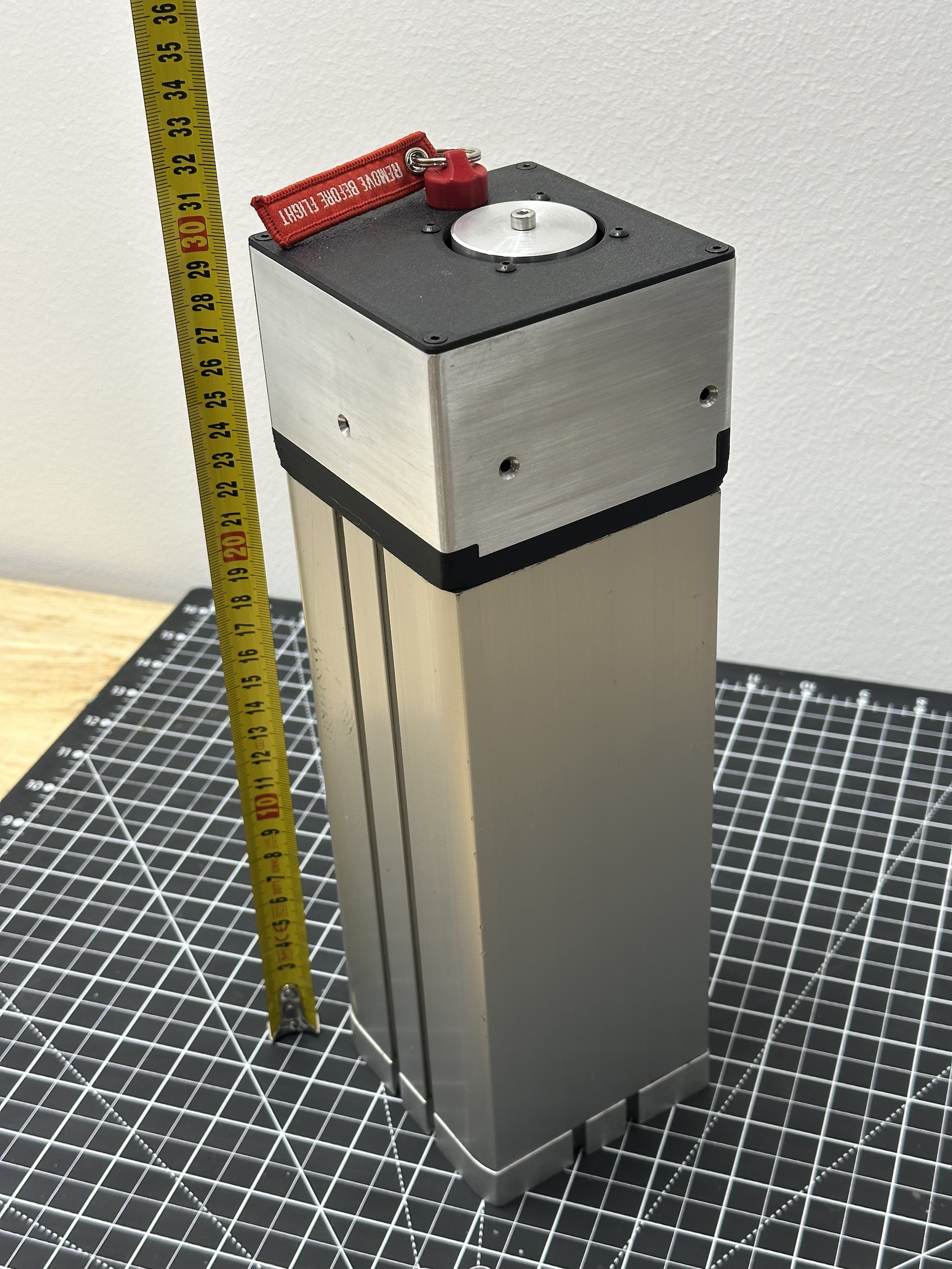
PADS is a plug-and-play manufacturing unit that integrates with most satellite platforms. It provides a standardized deployment interface for solar arrays, radiators, antennas, and other payloads requiring long, stable booms that cannot be folded and launched conventionally.
The system feeds stored structural material through a controlled deployment mechanism that shapes, stabilizes, and locks it into a rigid profile during exit. The result is a continuous, fully rigid boom produced directly from the module — without joints or external assembly. The entire process occurs autonomously in orbit.
KEY CAPABILITIES
The PADS manufacturing unit has passed all flight qualification tests and is launching on multiple missions in 2026 with ESA and Thales Alenia Space.
Peak power draw during deployment — less than a standard light bulb. UV curing eliminates the thermal processing overhead of melt-based additive manufacturing.
Boom cross-section is configurable between 38mm and 90mm to match structural and stiffness requirements for different payloads and deployment scenarios.
PADS operates as a closed system with zero debris release. Fully compliant with current and planned deorbiting and space sustainability guidelines.
Electrical connection between boom end and satellite base is maintained throughout deployment — enabling power and data transfer to the deployed payload.
Optional payload retraction and reentry capability. The payload can be retracted back into the module for reentry scenarios or repositioning.
PADS SPECS
Printer Assisted Deployment System is a single manufacturing tool that produces structural booms from 10 meters to over 100 meters. Power, complexity, and footprint stay constant — the only variable is raw material volume.
All values are nominal. Boom diameter adjustable between 38 mm and 90 mm. Custom configurations available on request.
PRODUCT ROADMAP
2027
Structural booms from 10 meters for satellite deployables. Plug-and-play module for solar arrays, radiators, and antennas. In flight validation now.
2028
Kilometer-scale solar arrays and radiators become structurally viable. Integrated with PADS, provides scale necessary for orbital data centers and commercial space stations.
2030+
On-demand construction not limited to booms. Refillable, standalone platform for space stations, data centers, and lunar infrastructure — producing structures of any geometry.
Download the complete PADS technical datasheet with detailed specifications, interface diagrams, and integration guidelines.
We'll send you the spec sheet and occasional product updates. Unsubscribe anytime.
Whether you're evaluating PADS for a specific mission or exploring large-structure deployment for future platforms — let's talk.
GET IN TOUCH